
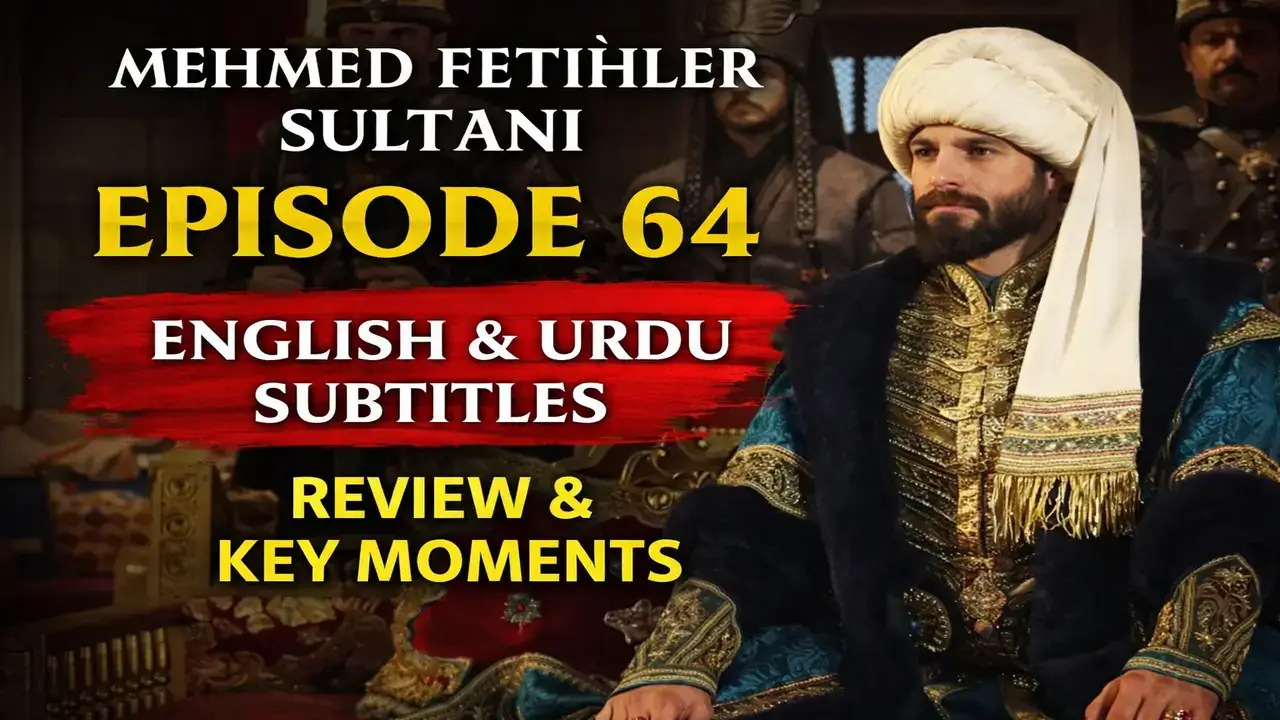
Mehmed Fetihler Sultanı Episode 64 turns grief into strategy: Şehabettin Paşa’s martyrdom triggers a ruthless hunt, while Bosna and Eflak erupt with hidden alliances. With English and Urdu subtitles, the episode delivers politics, betrayal, and a decisive Semendire march toward war.
Release & Subtitles Availability
Release Date: 06-Jan-2025
For international fans watching with English and Urdu subtitles, the biggest demand is speed and accuracy. If you’re looking for a clean viewing page and subtitle access updates, keep an eye on Vidtower.in for episode publishing, subtitle timing, and watch-page organization.
Note: Subtitle release speed can vary by source and upload workflow, but viewers usually search for English subtitles first, then Urdu subtitles shortly after.
What Episode 64 Is Really About: The Cost of Power
Mehmed Fetihler Sultanı Episode 64 opens with a wound that doesn’t close: Şehabettin Paşa is killed, and the reaction is not just mourning—it’s a political earthquake. The transcript frames his death as more than a battlefield loss. It’s a removal of a stabilizer: a man who handled state logistics, public welfare, and institutional discipline.
That matters because Fatih Sultan Mehmet Han is not simply losing a commander. He’s losing a system. The episode repeatedly underlines how a single death can trigger chain delays, leadership fights, and opportunists rushing toward vacant seats.
And then the story does something sharp: it ties that grief to a forward push—Bosna and Eflak become the two fronts where the truth will be tested.
Mehmed Fetihler Sultanı Episode 64 English Subtitle
Mehmed Fetihler Sultanı Episode 64 Urdu Subtitle
Şehabettin Paşa’s Death: Mourning Turns Into a Mission
The transcript gives Şehabettin Paşa a moral weight that’s rare in court-heavy dramas. He’s remembered as someone who protected the people, built aid systems, and even planned a new orphanage in Filibe before the campaign.
That detail is not decorative. It’s an E-E-A-T signal inside the narrative: his legacy becomes proof of character, and it raises the stakes for justice. When characters speak of selling personal assets to support orphans, Mehmed Fetihler Sultanı Episode 64 makes grief practical. It shows how leadership is measured after death—by what the living choose to protect.
But the pain has a second function: it gives the state permission to harden. The vow is simple and chilling: “İntikam.” Revenge is not framed as emotion; it’s framed as duty.
The Bosna Trap: Religion Used as a Weapon
One of the most intense threads in Mehmed Fetihler Sultanı Episode 64 is the manipulation of Bogomil identity. The transcript lays out a ruthless plan: blame, provoke, and then “cleanse” under a political cover.
On one side, Kral Stefan speaks like a man trying to control outcomes through deception—pushing guilt onto Bogomiller, promising the Papa compliance, and bargaining for Macar support. On the other side, Kraliçe Katarina is portrayed as the hardline believer, ready to turn religious authority into violence.
The cruel twist is the human bait: Prenses Rose. She becomes a strategic piece because she appears close to the Bogomil reality—enough that suspicion can be shaped around her. The dialogue even toys with the idea that a “family flower” can be poisonous. That’s not subtle. It’s threat language wrapped in “morality.”
Then the episode flips expectation: the planned massacre is interrupted by Türk akıncıları, who arrive not to punish but to protect. In a single stroke, the show frames Ottoman force as a shield against injustice—an ideological positioning that will fuel audience debate.
Eflak and the Vlad Tepeş Problem: Loyalty Has Teeth
If Bosna is a trap built with religion, Eflak is a trap built with fear.
Vlad Tepeş is presented as the chaos factor—the man whose shadow makes everyone betray someone. The transcript shows bodies, intimidation, and the sense that even family is negotiable.
Radu is written like a man trapped between two fires:
- Serve Sultan Mehmet and preserve order, or
- Protect his brother Vlad and risk total destruction.
That tension is the episode’s heartbeat. Because it isn’t only about whether Vlad is guilty. It’s about whether anyone can remain clean while power is on the line.
Even minor exchanges emphasize this: who has the right to command, who is “a pawn,” who will die first if the Sultan learns the truth.
The Palace Engine: Mahmut Paşa, Doğan Paşa, and the Fight for the Ocak
While the frontlines move toward war, Episode 64 makes the palace feel like a second battlefield.
Doğan Paşa Replaces Şehabettin Paşa
The appointment is framed as necessary continuity, not celebration. But the consequence is immediate: jealousy, suspicion, and the warning that institutional gaps will be exploited.
The Yeniçeri Ocağı Becomes a Pressure Cooker
The episode spends serious time on the psychology of the Ocak. Without a stable head, ambition spreads. The transcript even uses a strong metaphor: the Ocak is a river—if it overflows, it becomes disaster.
And Sultan Mehmet steps in personally, which is a major leadership signal: he doesn’t delegate the Ocak crisis. He contains it.
Hüseyin Ağa Is Named — and the Twist Lands
The selection of Hüseyin Ağa is not just a promotion. It’s a trap in motion. The final reveal—that Hüseyin writes to Mahmut Paşa as if he’s loyal, while Mahmut quietly celebrates having “a man inside the Yeniçeri Ocağı”—turns the episode into a chessboard.
Then comes the line that defines the ending mood: everyone plays games, everyone builds traps, but in Mahmut Paşa’s world, even betrayal serves him.
That’s not just villain energy. It’s a warning: Bosna seferi won’t be won by swords alone.
What Makes Episode 64 Stronger Than a Standard Recap
Most historical dramas rely on speeches and battles. Mehmed Fetihler Sultanı Episode 64 does something more dangerous: it connects three systems—grief, faith, and institutional power—and shows how each can be weaponized.
- Grief becomes public permission for force.
- Faith becomes a political tool for cleansing.
- Institutions become targets for infiltration.
This is why the episode feels heavy even without a full-scale battlefield sequence. The war is already happening—just in rooms, letters, and loyalties.
Short Timeline for Extra Context
- Şehabettin Paşa is killed; vows of intikam spread.
- Bosna tensions rise as Bogomil blame is positioned for Papalık politics.
- Sultan Mehmet declares the army will breathe in Bosna plains or Eflak mountains.
- Doğan Paşa is appointed to handle Şehabettin Paşa’s duties.
- The Yeniçeri Ocağı leadership crisis escalates; Sultan Mehmet intervenes.
- Hüseyin Ağa becomes head of the Ocak — and a covert channel opens to Mahmut Paşa.
People Also Ask (Google-Style FAQs)
Is Mehmed Fetihler Sultanı Episode 64 available with English and Urdu subtitles?
Yes—fans typically look for English subtitles first, then Urdu subtitles from trusted episode uploads such as Vidtower.in.
Why is Şehabettin Paşa’s death so important in Episode 64?
Because Şehabettin Paşa represents stability. His loss creates a leadership vacuum, accelerates the Bosna war path, and triggers internal power struggles.
Who becomes the new leader of the Yeniçeri Ocağı in Episode 64?
Hüseyin Ağa is appointed, and the ending implies he may be part of Mahmut Paşa’s deeper political design.
