
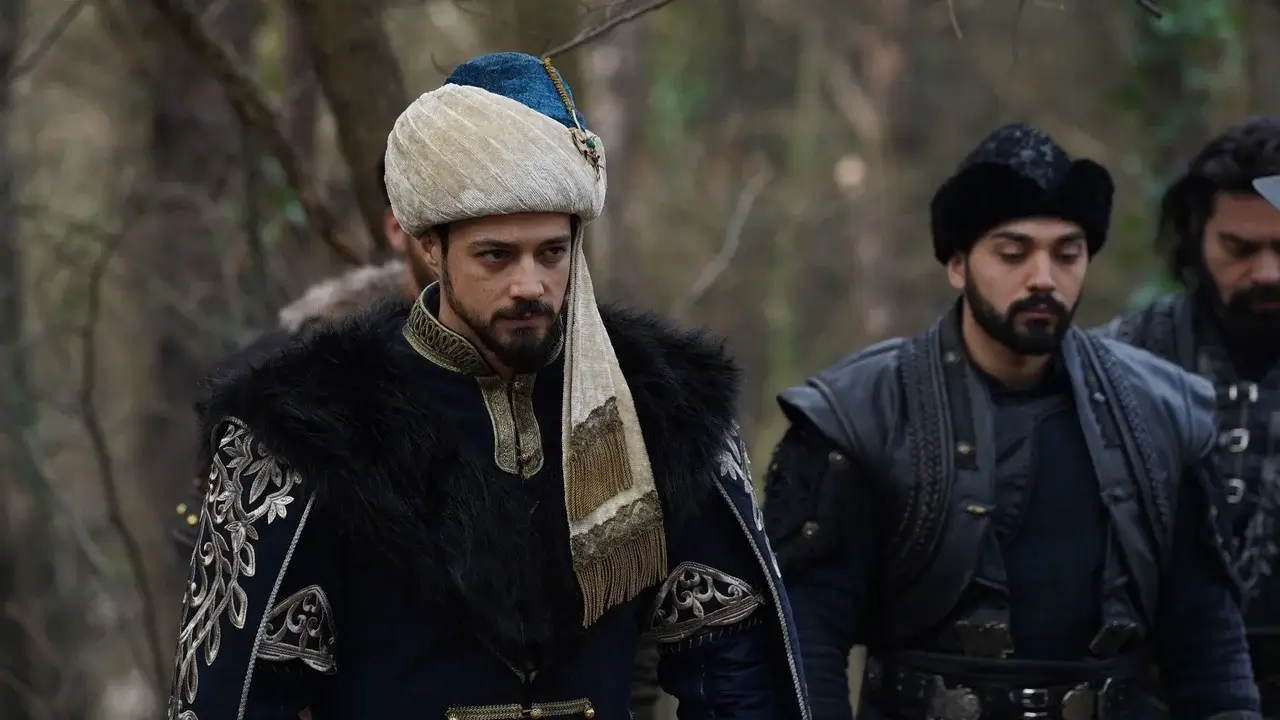
The tranquil sanctity of a Sufi tekke is about to become a battlefield. As Kurulus Orhan Episode 14 approaches its February 11, 2026 release, the spiritual journey Sultan Orhan embarks upon in Episode 13’s closing moments conceals a lethal trap orchestrated by Princess Asporça and Commander Flavius—a conspiracy that could end the Ottoman dream before it truly begins.
Check Also: Mehmed Fetihler Sultanı Episode 69 English and Urdu Subtitles
English Subtitles:
Urdu Subtitles:
Episode 13 Recap: The Web of Betrayal Tightens
Episode 13 delivered seismic political shifts that reshaped the entire Anatolian landscape. Sultan Orhan’s public humiliation of Temurtash before gathered Turkic beylik envoys wasn’t merely theater—it was strategic messaging that declared the age of Mongol domination finished. The chained Ilkhanid governor represented 100 years of oppression broken by Ottoman will.
But the episode’s most consequential development emerged from Byzantine desperation. Emperor Andronikos III, cornered by internal rebellion and Ottoman military pressure, accepted Sultan Orhan’s terms: Ottoman forces would garrison between Iznik and Izmit, protecting the emperor from his own grandson Yohannes’ coup attempt. The price? One Gemlik harbor and a dynastic marriage between Orhan and Princess Asporça.
Alaeddin Bey’s successful diplomatic mission to Constantinople exposed the depths of Byzantine internal rot. Yohannes’ hired assassins nearly killed the emperor during an arena ceremony before Alaeddin and Flavius intervened. The emperor’s survival came at the cost of accepting Ottoman hegemony over his remaining territories.
Meanwhile, Fatma Hatun’s engagement to Yiğit Alp proceeded despite her obvious heartbreak over Flavius. The ceremonial sherbet drinking masked emotional devastation, creating a powder keg of suppressed feelings that will inevitably explode.
The Tekke Assassination: Dafne’s True Allegiance Revealed
Episode 13’s final sequence shattered assumptions about loyalty and identity. Dafne, Asporça’s trusted handmaiden, attempted to murder the princess in her own chambers. The shocking betrayal revealed Dafne’s true allegiance: not to Asporça, not to Byzantium’s throne, but to the abstract ideal of “Holy Rome” itself.
Dafne’s chilling declaration—”Your dynasty is leading Holy Rome to destruction. I will not allow it”—exposed a fanatical devotion that transcends personal relationships. She views Emperor Andronikos’ pragmatic accommodation with Sultan Orhan as existential betrayal deserving of death.
The attempted assassination failed, but Dafne’s escape guarantees she remains a threat. More critically, her final words to Asporça planted the seed that will bloom into Episode 14’s conspiracy: “Orhan must die before this war ends. Every method is permissible to end this war.”
Asporça’s Calculated Response: Alliance with Orhan’s Enemies
Princess Asporça’s transformation from reluctant diplomat to active conspirator represents the series’ most significant character evolution. Her conversation with Flavius after learning of the forced marriage revealed cold strategic calculation beneath the emotional outrage.
The princess correctly identified that Sultan Orhan’s expansion threatens not just Byzantine territory but the empire’s psychological foundation. Bursa fell without prolonged siege. Iznik now sits under Ottoman protection. Gemlik’s harbor provides naval access. Each concession erodes Byzantine prestige while strengthening Ottoman legitimacy.
Asporça’s declaration—”I will start a rebellion against my own father if necessary, but I will neither marry Orhan nor surrender Bursa and Iznik”—signals she views the marriage demand as the final indignity requiring desperate countermeasures.
Her strategic conclusion mirrors Dafne’s fanaticism through different reasoning: “Whoever opposes Orhan in the frontier regions is naturally our friend. We must fight Orhan like Orhan fights.” This adopts Ottoman strategic methods while building an anti-Orhan coalition among jealous Turkic beyliks.
The Tekke Trap: Spiritual Sanctuary as Killing Ground
Sultan Orhan’s Episode 13 visit to the tekke represented genuine spiritual seeking. His humble approach—removing royal regalia, presenting himself as “a servant seeking love of the Truth”—reflected Islamic traditions of sultans shedding worldly authority before Sufi masters.
The sheikh’s welcoming response—acknowledging that Orhan’s presence at the threshold proved divine acceptance—established the tekke as sacred space. This makes the planned assassination even more profane. Attacking someone during spiritual retreat violates fundamental codes of both Islamic hospitality and Byzantine Christian honor.
Kurulus Orhan Episode 14 will transform this sanctuary into an ambush site. The mevlevi ceremony Orhan participates in—the whirling meditation accompanied by ney flute and spiritual poetry—provides the perfect cover. Surrounded by dervishes in ecstatic rotation, assassins can approach undetected until the killing stroke.
The Yunus Emre poetry referenced in Episode 13’s closing moments takes on sinister meaning: “I grabbed the skirt of a pir (master)… I couldn’t reach the right path… my sins are many, my face is black.” These verses about spiritual inadequacy will underscore the moral corruption of murdering a seeker during worship.
Bursa’s Ethnic Tensions: The Ahilik-Rum Merchant Conflict
Episode 13 introduced simmering commercial tensions that Asporça’s agents will exploit. The confrontation between Muslim ahi craftsmen and Christian Rum merchants over marketplace positions revealed competing economic visions for Bursa’s future.
Boran Bey’s intervention prevented immediate violence, but his warning that “Sultan Orhan will issue a decree establishing trade order, with equitable taxation for both Muslim and non-Muslim” threatens vested interests on both sides. Muslim guilds fear losing traditional privileges. Christian merchants suspect any “equitable” system will favor the new Muslim ruling class.
The ahi tekke attack Sheikh Edebali mentioned—where Rum merchants supposedly killed ahi members—provides the pretext for Kurulus Orhan Episode 14’s escalation. Whether the attack genuinely occurred or represents false-flag provocation remains unclear, but the result is identical: communal violence that undermines Sultan Orhan’s authority.
Dafne’s escape after her failed assassination attempt positions her perfectly to coordinate this unrest. Her knowledge of palace routines, fluency in both Greek and Turkish, and fanatical commitment make her the ideal agent provocateur to ignite Bursa’s ethnic powder keg.
The Karesi Beylik Question: Demirhan Bey’s Dangerous Game
Demirhan Bey’s volatile reaction to Sultan Orhan’s Biga harbor request created another crisis vector. His furious rejection—”We have no harbor to gift or rent”—masked deeper anxieties about Karesioğulları autonomy.
Demirhan correctly perceives the harbor request’s strategic implications. Biga controls access to the Dardanelles strait. Ottoman presence there would position forces for eventual assault on Constantinople itself. What begins as commercial “rental” inevitably becomes permanent occupation, then outright annexation.
The Ilkhanid envoy seeking Temurtash’s extradition complicated Demirhan’s calculations further. Eretna Bey arrived offering an anti-Orhan coalition: if Karesi, Germiyan, Candar, and other Turkic beyliks unite with Ilkhanid backing, they could “crush Orhan and that thing called the Ottoman state.”
Episode 14 will force Demirhan’s choice. Does he recognize Sultan Orhan’s sultanate and accept profitable trade partnership? Or does he join Asporça’s expanding conspiracy, betting that coordinated opposition can destroy Ottoman power before it consolidates?
Dursun’s Internal Conflict: The Spy Who Couldn’t Betray
Dursun’s brutal beating by his brother highlighted the series’ exploration of conflicting loyalties. Sent to infiltrate Orhan’s forces after İdris Alp’s death, Dursun instead found himself genuinely converted to the Ottoman cause.
His brother’s demand—”You will bring me Temurtash”—represented an impossible choice. Stealing Temurtash from custody would betray Sultan Orhan’s trust. Refusing would dishonor his Karesioğulları blood ties and endanger his family.
The beating’s savagery—”Are we not Turks? Are we not Turks?”—weaponized ethnic identity against political allegiance. Dursun’s brother framed opposition to Orhan as defense of Turkic autonomy against an expansionist sultanate, ignoring that Orhan himself champions pan-Turkic unity against both Mongol and Byzantine threats.
Halime’s tender care for Dursun’s injuries demonstrated her growing feelings, but Dursun’s explanation—”I saw a wild horse and followed it, so it did this”—revealed he cannot confess the truth. Episode 14 must resolve whether Dursun ultimately chooses blood or belief.
Nilüfer’s Suspicions: The Shadow Over Asporça
Nilüfer Hatun’s distrust of Princess Asporça escalated from vague unease to open confrontation. Her accusation after the ambush—”Every time we work with you, either blood is spilled or our secrets are exposed”—articulated suspicions Sultan Orhan himself shares.
The logic was damning: only Asporça, Alaeddin, and Flavius knew Temurtash’s location. Alaeddin wouldn’t betray his brother. Therefore, Asporça must have informed her agents. The princess’s outraged denial and Nilüfer’s warning—”This suspicion doesn’t end here”—established permanent mutual hostility.
Sultan Orhan’s final instruction to Esma—”From now on, keep your eyes on Dafne”—proved prophetic but arrived too late. Dafne had already attempted Asporça’s murder and escaped. Episode 14’s dramatic irony will stem from Orhan hunting the wrong enemy while the real threat approaches his unguarded moment of worship.
Kurulus Orhan Episode 14 Predictions: The Tekke Becomes a Killing Field
February 11, 2026 will deliver the assassination attempt building since Episode 11’s introduction of Byzantine internal conspiracies. Sultan Orhan’s spiritual vulnerability—stripped of armor, surrounded by strangers, absorbed in meditative prayer—creates perfect killing conditions.
Expect Episode 14 to intercut between three parallel crises:
The tekke attack will begin during the mevlevi ceremony’s climax. Assassins disguised as dervishes will strike when Orhan is most defenseless. Boran Bey and loyal alps will fight desperately to protect their sultan, but the confined space and element of surprise favor the attackers.
Bursa’s ethnic riots will erupt simultaneously, preventing reinforcements from reaching Orhan. The coordinated timing proves Asporça’s conspiracy operates through multiple cells. Sheikh Edebali’s ahi followers will clash with Rum merchants while the city burns, forcing Alaeddin to choose between rescuing his brother and preventing complete urban collapse.
Demirhan Bey’s final decision regarding the Ilkhanid alliance will determine whether Orhan faces internal enemies alone or backed by hostile neighboring beyliks. If Demirhan commits to the anti-Orhan coalition, Episode 14 could end with Karesi forces marching toward Ottoman territory.
Character Analysis: Asporça’s Moral Descent
Princess Asporça’s journey from proud Byzantine noble to conspiracy architect mirrors historical patterns of imperial decline. Her father’s pragmatic surrender of territory horrifies her not because it’s strategically wrong but because it undermines the psychological fiction of Byzantine invincibility.
Her statement—”Even if it means rebelling against my father, I will neither marry Orhan nor surrender Bursa and Iznik”—reveals she values abstract imperial prestige over her father’s life, her own safety, or thousands of civilian lives that continued warfare will claim.
This fanaticism paradoxically mirrors Sultan Orhan’s own devotion to his vision of pan-Turkic Islamic unity. Both leaders sacrifice personal happiness for political missions they consider historically ordained. The difference lies in methods: Orhan builds through justice and inclusion; Asporça destroys through conspiracy and ethnic division.
Historical Context: The Real Orhan-Theodora Marriage
Historical records confirm that Orhan Gazi did marry a Byzantine princess, though sources debate whether she was Theodora (daughter of John VI Kantakouzenos) or Asporça (daughter of Emperor Andronikos III). The marriage occurred around 1346 as part of a military alliance.
The series compresses and dramatizes this history. The real marriage followed Orhan’s support for John Kantakouzenos during Byzantine civil war, not threats from Princess Asporça’s assassination plots. But the underlying dynamic—Byzantine desperation buying peace through dynastic marriage—accurately reflects 14th-century reality.
The historical Orhan-Theodora union produced Halil Bey, who was later captured and ransomed during Ottoman-Byzantine conflicts. This suggests the marriage created genuine family bonds despite its political origins, contradicting Asporça’s assumption that it would remain purely transactional.
Thematic Elements: Sacred Space Violated
The tekke assassination attempt explores how political violence corrupts spiritual sanctuaries. Islamic tradition strictly prohibits bloodshed in mosques, tekkes, and other sacred spaces. Attacking Sultan Orhan during sema (whirling meditation) represents the ultimate profanation.
Episode 14 will likely emphasize this through Sheikh Edebali’s response. The elderly spiritual master has counseled Orhan throughout the series, providing moral grounding for political decisions. Witnessing violence in his tekke will force him to confront whether political engagement inevitably taints spiritual purity.
Yunus Emre’s poetry throughout Episode 13 prepared this theme: the struggle to maintain spiritual authenticity while exercising worldly power. Orhan’s tekke visit represented his attempt to remain grounded in humility despite sultanate authority. The assassination attempt will test whether power and spirituality can coexist.
Production Quality: Elevating Historical Drama Standards
Kurulus Orhan continues the production excellence established by Diriliş Ertuğrul and Kuruluş Osman. The Episode 13 tekke sequences demonstrated particular attention to authentic Sufi ceremonial practices, with carefully choreographed sema performances and period-accurate musical instruments.
The Bursa marketplace set design reflects meticulous historical research, showing the multi-ethnic commercial character of early Ottoman cities. Christian and Muslim merchants operating side-by-side, guilds maintaining traditional privileges, and emerging Ottoman administrative structures all appear with documentary precision.
Combat choreography continues emphasizing brutal realism over Hollywood spectacle. The arena assassination attempt on Emperor Andronikos featured rapid, chaotic close-quarters fighting rather than extended duels, capturing medieval combat’s terrifying unpredictability.
Releasing Details and Where to Watch
Release Date: February 11, 2026
Platform: TRT 1 (Turkey)
Subtitles: English and Urdu subtitles available at Vidtower.in
Episode Number: 14
Expected Duration: 120-140 minutes
Vidtower.in has become the premier destination for international viewers, providing high-quality English subtitles typically within 2-4 hours of Turkish broadcast. The translation team maintains exceptional accuracy while preserving the poetic Ottoman Turkish dialogue that defines the series’ linguistic character.
Fan Theories: Will Orhan Survive the Tekke Attack?
Online communities debate whether Sultan Orhan will suffer serious injury during Episode 14’s assassination attempt. Some theorists argue a near-fatal wound would provide character development opportunities, forcing Orhan to confront mortality while demonstrating Ottoman governance can continue during his incapacitation.
Others note that historical Orhan Gazi lived until 1362, making his 1326 death historically impossible. However, the series has demonstrated willingness to compress timelines and alter minor historical details for dramatic purposes, so survival isn’t absolutely guaranteed.
A third theory suggests Boran Bey or another loyal alp will die protecting Orhan, providing the necessary dramatic sacrifice while keeping the protagonist alive. This would emotionally devastate Orhan while avoiding historical contradiction.
The Fatma-Yiğit Marriage: Disaster Waiting to Happen
The Episode 13 engagement ceremony created palpable tension beneath surface celebration. Gonca Hatun’s advice—”Fatma must forget both her pain and that merchant”—acknowledged that this marriage represents escape rather than genuine love.
Yiğit’s obvious joy contrasted heartbreakingly with Fatma’s forced smiles. His statement—”Your wish is my command”—regarding wedding location showed he’ll accommodate her every request, not recognizing that compliance won’t create the emotional connection Fatma craves.
Episode 14 will likely feature wedding preparations that force Fatma to confront her choice’s irreversibility. The appearance of Flavius at some point—whether to reconcile with Asporça or coordinate the assassination plot—will test Fatma’s resolve when her lost love reappears.
Alaeddin’s Diplomatic Triumph: Redefining Ottoman Statecraft
Alaeddin Bey’s successful Constantinople mission demonstrated that Ottoman power operates through diplomatic sophistication as much as military might. His exposure of Yohannes’ treason, rescue of Emperor Andronikos, and negotiation of favorable terms established him as statesman equal to any Byzantine courtier.
The Gemlik harbor concession represents strategic genius. Rather than conquer through prolonged siege, Alaeddin secured Ottoman naval access through treaty, preserving resources for future campaigns. The marriage condition—initially seeming like Byzantine leverage—actually serves Ottoman interests by legitimizing territorial gains through dynastic alliance.
Episode 14’s assassination conspiracy will test whether Alaeddin’s diplomatic achievements can withstand Asporça’s violent opposition. If the conspiracy succeeds in killing or seriously wounding Orhan, all diplomatic gains collapse as Byzantine-Ottoman relations return to total war.
The Broader Historical Canvas: Anatolian Unification
Sultan Orhan’s Episode 13 speech to gathered beylik envoys articulated his historical mission: transforming fragmented Turkic principalities into unified Islamic polity. His declaration—”Let us make the frontiers I freed from the yoke into our eternal homeland by standing shoulder to shoulder”—invited voluntary federation rather than forced conquest.
The lukewarm response from Karesi, Germiyan, Candar, and other beylik representatives revealed the challenge. These principalities enjoyed autonomy under nominal Ilkhanid overlordship. Why surrender independence to an upstart sultan whose father was a minor bey just decades earlier?
Episode 14’s conspiracy represents these beyliks’ answer: better to destroy Ottoman pretensions now than face eventual subjugation later. The historical irony is that their resistance will ultimately justify the very Ottoman expansion they feared, as subsequent sultans will conquer the beyliks that refused Orhan’s peaceful unification offer.
Conclusion: The Price of Ambition
Kurulus Orhan Episode 14 will answer whether Sultan Orhan’s rapid expansion has outpaced his ability to consolidate gains. The simultaneous crises—assassination attempt, urban riots, potential beylik coalition—all stem from success generating enemies faster than allies.
The tekke assassination particularly symbolizes this dynamic. Orhan sought spiritual grounding precisely because worldly power threatened to corrupt his soul. That the moment of humble seeking becomes his point of maximum vulnerability represents the tragic cost of leadership.
For international viewers seeking the complete experience with English subtitles, Vidtower.in provides essential access. The February 11, 2026 broadcast promises to be one of the season’s most intense episodes, combining spiritual themes with political violence in ways that will redefine both Sultan Orhan’s character and the series’ direction.
The question isn’t whether Orhan survives—historical records confirm that—but what price he’ll pay for survival, and how the conspiracy’s exposure will reshape his approach to both enemies and supposed allies.
Frequently Asked Questions
When does Kurulus Orhan Episode 14 release?
Episode 14 releases February 11, 2026 on TRT 1, with English subtitles available at Vidtower.in within 2-4 hours of Turkish broadcast.
What is the main conflict in Episode 14?
Princess Asporça orchestrates an assassination attempt against Sultan Orhan during his visit to a Sufi tekke, while simultaneously triggering ethnic riots in Bursa to prevent rescue.
Will the Orhan-Asporça marriage happen?
Emperor Andronikos demands the marriage as condition for territorial concessions, but Asporça has vowed to prevent it through rebellion and assassination, making the marriage’s future uncertain.
Who is Dafne and why did she attack Asporça?
Dafne is Asporça’s handmaiden who attempted assassination because she believes the Byzantine royal family is betraying “Holy Rome” through accommodation with Orhan, demonstrating fanatical loyalty to imperial ideology over individuals.
